
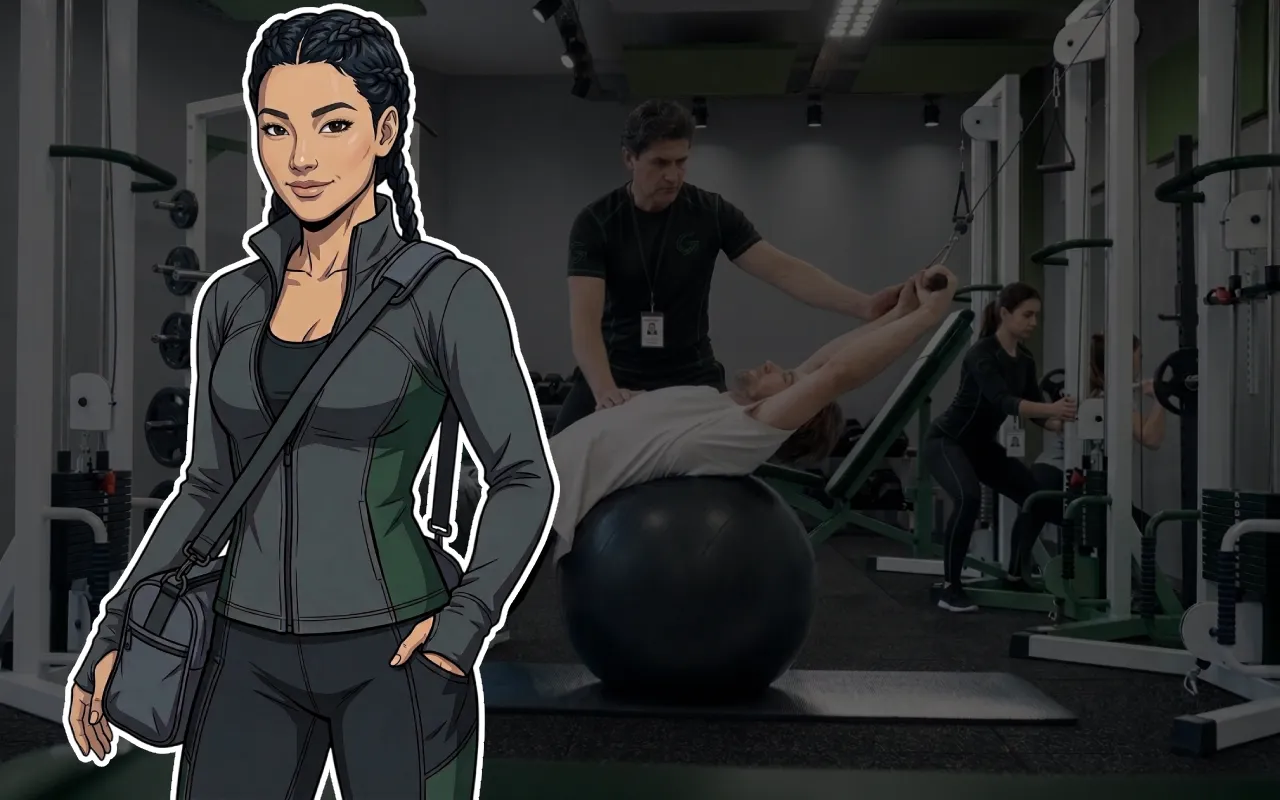
Gym Business Plan: How a Town of 2,000 Reaches $10,000 a Month
Imagine Airin at the gas station in Tonopah, Nevada, standing behind a man in a hi-vis shirt who cannot turn his head to look at the drinks cooler. He turns his whole body instead, like a crane. He is maybe thirty-five, he has just come off a twelve-hour shift in a haul truck, and the nearest physical therapist is a long drive and an unpaid day off away. That moment is where this gym business plan starts, and the first version of it did not survive its own arithmetic.
This story is based on real projects and real requests from our clients. The numbers below come from the financial model built for this case, and the analysis methods behind it (POSCO, ABCR, SUP and BFM) are the same ones we run on real businesses.
The full plan, free PDF
The whole Headframe Strength plan as a PDF, free to download. The town-of-2,000 math, the employer pivot, and the month the model clears $10,000.
Get the free PDFThe full package
The ten files behind a case like this one: the plan, the 25-month model with live formulas, the lender package and the deck.
Get a packageYour own model
The same work, built for your idea, your town and your numbers, with the math checked against real channel ceilings.
Order a custom buildThe town this gym business plan starts in
Tonopah sits on US-95 halfway between Las Vegas and Reno, with a little more than 2,000 residents and a median household income of about $37,000 against roughly $81,000 for Nevada. The town hospital closed more than ten years ago. Three small gyms already operate on and around Main Street, none of them with a website or a published price.
What the town does have is work. Kinross Round Mountain employed 880 people and 153 contract workers. The ioneer Rhyolite Ridge lithium-boron project brings 400 to 600 construction workers at peak. Centerra Gold is developing the Goldfield project thirty miles south, Albemarle runs lithium at Silver Peak, and the county, the state road crews and the Tonopah Test Range contractors fill in the rest. Thousands of people work ten- and twelve-hour shifts inside ninety minutes of a town with no clinic worth the drive.
What the first numbers said
Before a lease is signed, we run a break-even model on the main product. It asks a blunt question: add every fixed cost, add the cost of opening, decide how fast you want it back, and how many people have to pay your price for that to happen.
Fixed costs came to about $6,400 a month: rent on Main Street, propane heat at six thousand feet, insurance, software, cleaning, a part-time coach and the loan payment. Opening the doors costs $54,425. At $49 a month, after card fees and taxes, one member leaves about $33.
The answer was 314 members, in a town that can hold about 160. The gym was not a bad idea. It was a bad engine.
Three versions that failed before the gym business plan worked
Version one: the straight gym
Racks, a rubber floor, a key fob on the door and $45 a month. Even taking half of every person in Tonopah who has ever held a gym membership leaves the owner one to two thousand dollars a month, and month three is a loss. In a market this size, the ceiling arrives before the business does.
Version two: sell more to the same people
Personal training, nutrition coaching, a supplement shelf. Every gym owner tries it. In a town with a $37,000 median income the demand for $60 sessions is thin, and each one costs an hour of the founder's own life. The model stalled near four thousand dollars a month with Airin working every hour the doors were open.
Version three: go national with an app
A $19 app for shift workers everywhere. Competitor scoring put it next to companies with venture money and celebrity trainers, and consumer fitness apps pay sixty to ninety dollars to win a subscriber who often leaves within four months. The model burned cash for a year and missed the month-three target completely.
The conversation that changed the direction
The turn came from a retired shift boss with thirty-one years at the mine, who now drives a school bus because sitting still made him feel older than he was. He described the morning stretch every crew does: five minutes, half the crew faking it because the person leading it does not believe in it either, and every year somebody tearing a shoulder climbing into a cab.
The National Safety Council puts the average cost of one medically consulted work injury at $48,000, and the total cost of US work injuries in 2024 at $181.4 billion. That is the number that reframed the whole business. A worker pays $49 a month with their own money. An employer pays to avoid a $48,000 event, out of a budget that already exists.
What competitor scoring said the price should be
We score every real competitor on product, online presence, service, brand strength and physical presence, then set the price from where the business actually lands. For the employer program, the field is national firms that embed athletic trainers in large plants. Every one of them is hundreds of miles from central Nevada.
Employer injury-prevention providers, scored
The scored price for what Airin can deliver came out at $6,213 a site. She prices it at $4,800 on purpose. The first four contracts buy references that no amount of marketing buys, and $4,800 a month is about one tenth of a single injury, which is the sentence that makes a safety manager say yes.
The product ladder that carries the profit
A product line works when each rung has a job: something free to start a relationship, something cheap to prove quality, a main product, a premium product and a recurring layer. Here the gym is the front door and the employer program is the engine.
Five rungs, two of them doing the heavy lifting
How a gym business plan reaches $10,000 a month
The gym opens in January. Members come from the storefront on US-95, flyers in the motels and RV parks where rotation crews sleep, and geo-targeted ads covering Goldfield, Silver Peak and Smoky Valley. The employer line starts before the doors open, because a free Injury Risk Walk needs nothing except the founder, a site induction and thirty minutes.
Where the money comes from in month 12
Four employer contracts produce more revenue than 135 members, and they cost less to serve. That split is the whole argument of this plan: the gym is what makes the business real to the town, and the crews on the sites are what make it profitable.
What a lender sees
The $50,000 request is an SBA Microloan over 72 months, with a payment of $939 and the owner putting in $20,000 of her own money, which is 29% of the project. Projected debt-service coverage is 6.7 times in year one against the 1.25 that lenders look for. Months one and two sit below that line, because the gym opens before the first employer contract is signed, and the package says so in plain type instead of hiding it.
The loan buys a floor, racks, a keyless door, a sign and working capital. The owner's money buys the deposit, the legal work, the certifications, the insurance and the opening campaign. A lender can see which dollar went where on a single page, and the three linked statements behind it balance to zero in every period.
What another founder can copy from this
Ask what the ceiling is before you ask what the price is
Every local business has a number of customers the place can physically hold. Work it out first: population, participation rate, the competitors already there. If the break-even number is higher than the ceiling, no amount of marketing fixes it and the product line has to change.
Find the buyer with a budget line already open
Consumers pay from disposable income, and in a $37,000-median town there is not much of it. Employers pay from a safety budget that exists whether or not anyone spends it well. The same skill, sold to the second buyer, changes the arithmetic completely.
The full plan, free PDF
The whole Headframe Strength plan as a PDF, free to download. The town-of-2,000 math, the employer pivot, and the month the model clears $10,000.
Get the free PDFThe full package
The ten files behind a case like this one: the plan, the 25-month model with live formulas, the lender package and the deck.
Get a packageYour own model
The same work, built for your idea, your town and your numbers, with the math checked against real channel ceilings.
Order a custom buildQuestions founders ask about this plan
What does a gym business plan need to include?
A narrowed niche, a price justified against real competitors, a break-even model for the main product, a product line from free offer to recurring revenue, a month-by-month financial model with honest conversion ceilings, and a funding request with use of proceeds and debt-service coverage. The Headframe package covers all of it across ten files, including three linked GAAP statements for the lender.
How much does it cost to open a small-town gym?
In this plan, $54,425 to open plus $15,575 of working capital, financed by a $50,000 SBA Microloan and $20,000 of owner equity. The biggest lines are used commercial equipment ($24,000), build-out ($9,000) and keyless access control with cameras ($4,800).
Why sell to employers instead of only to members?
Because the math says so. A member pays $49 from their own pocket and the town holds about 160 of them. An employer pays $4,800 a month from a safety budget to avoid injuries that cost $48,000 each on average. Four contracts produce 63% of month-12 revenue.
Can a gym business plan work in a town of 2,000 people?
As a membership business alone, no: the break-even number was 314 members against a ceiling of about 160. It works when the gym is the visible home of a service sold to employers within a 90-minute drive and licensed to contractors across the country.
Is on-site injury-prevention coaching a medical service?
Not in this plan. Every session is non-clinical coaching and education, with no diagnosis and no treatment, and workers who report discomfort are referred to the employer's medical provider. Nevada licenses the title of athletic trainer, so the business never uses it and a licensed clinical advisor reviews the scope.
What happens if the mining projects are delayed?
The model counts only employers that exist today, with a ceiling of four contracts in year one. New construction raises the ceiling in year two rather than carrying year one. A downside case with half the close rate still turns profitable, reaching $10,000 a month in month 13 instead of month 10.
How long does a package like this take to build?
One working session. You give the town, the idea and what you already have; we run the productology, the competitor scoring and the 25-month model, then deliver the files. Start at momohero.com or read how the methods work on the methods page. The injury cost figures in this article come from the National Safety Council.